
Last week, a renovation contractor we work with in West Vancouver took the number-one Map Pack spot for "kitchen renovation west vancouver" — beating Heilman Renovations, a 267-review competitor, with only 17 reviews on his Google Business Profile. The same week, our dog-walking client in Chilliwack outranked a competitor with 34 reviews using just 25 of her own. The pattern is the same in both cases: structure, schema, and clean answers beat raw signals.
That is exactly what Google's AI Overviews reward right now. Old-school SEO chased backlinks and review counts. AI Overviews chase clean question-and-answer content, structured data, and entity signals — fields where a small Abbotsford or Mission business can match a 50-person Vancouver agency on technical fundamentals.
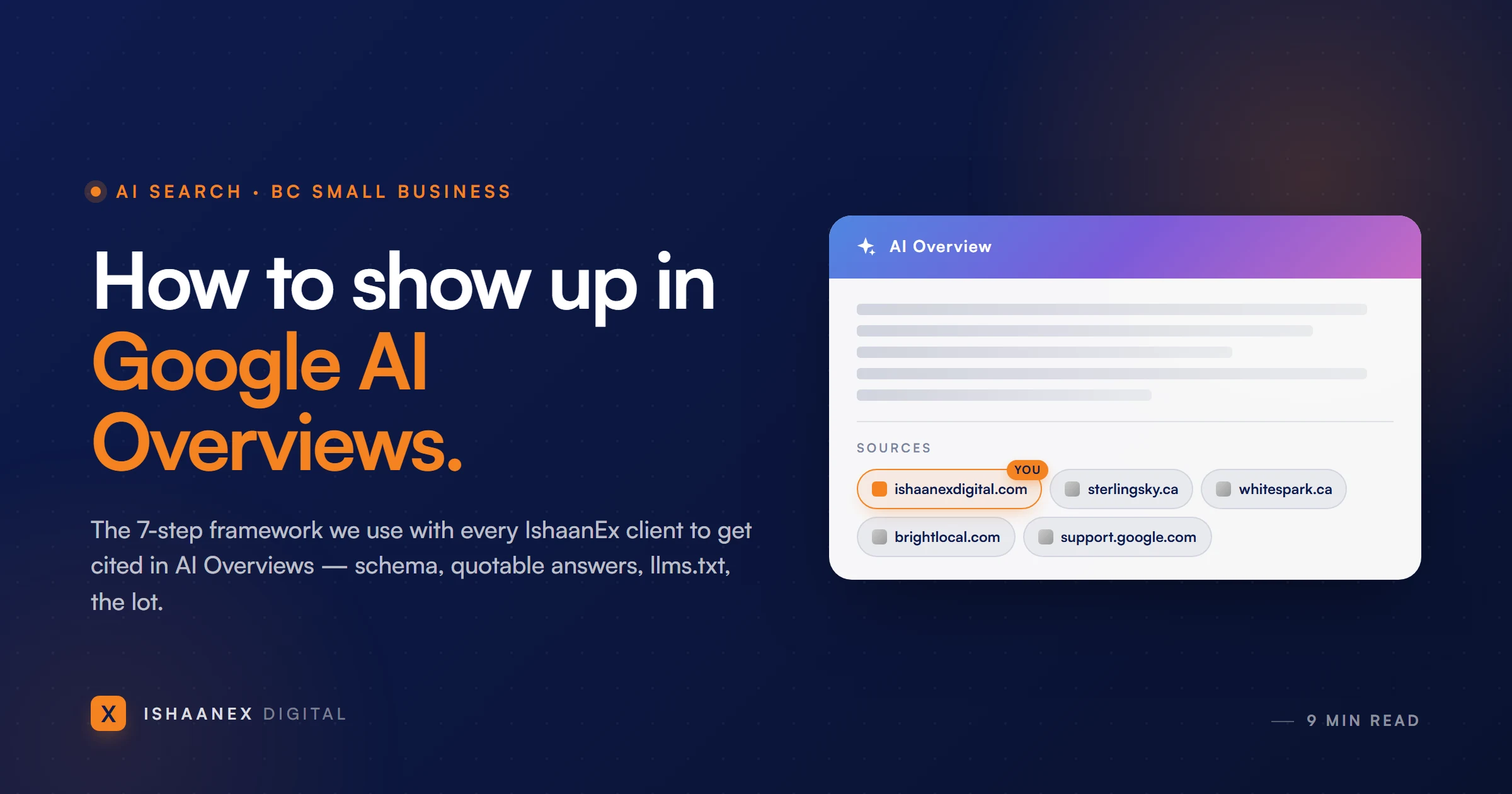
This guide is the practical 7-step framework I use with every IshaanEx Digital client to get them showing up in Google AI Overviews. Plain English, no developer required to read it, and every step ordered by how much it actually moves the needle for local service businesses across the Lower Mainland.
What is a Google AI Overview, and why does it matter for BC small businesses?
A Google AI Overview is the AI-generated answer that appears at the top of a Google search before the regular blue links. Instead of clicking a website, the user reads a synthesised paragraph that pulls facts and quotes from several sources — and Google credits each source with a small linked citation. That citation is the new front door.
AI Overviews now appear in over half of all Google search results according to Snezzi's 2026 research, and cited sources see about an 18% click-through rate lift on top of normal organic traffic. The flip side is real too — sites that rank but never get cited see traffic decline. The shift is no longer optional for any BC small business that wants to keep getting calls from Google.
Why are AI Overviews changing local search in BC?
The most important shift for local service businesses is who gets quoted. Older Google features mostly pulled from the top 10 organic results. AI Overviews pull from a much wider pool — ALM Corp's 2026 analysis shows that citations from top-10 ranking pages dropped from 76% in 2025 to 38% in 2026. Roughly 46.5% of cited URLs now rank outside the top 50 organic results entirely.
For a small Abbotsford or Chilliwack business, that is a real opening. You no longer need to outrank an agency with 200 backlinks to get quoted in front of a customer. You need a clean answer, valid schema, and a complete Google Business Profile. The bar is technical, not budget-based.
The other change worth knowing: on January 27, 2026, Google upgraded AI Overviews globally to Gemini 3. Stackmatix tracked the impact — about 42% of previously cited domains were replaced, and the new system surfaces 32% more sources per response. Every BC business has a fresh chance to land on the citation list right now.
How does Google decide which businesses to cite in an AI Overview?
Google's AI does not pick the prettiest website — it picks the easiest source to extract a clean answer from. Three signals dominate. First: the page directly answers a real question in 40 to 60 words placed under a question-style heading. Second: the page has valid structured data (LocalBusiness, Service, FAQPage schema) so the AI can identify the entity, the service, and the location with no guessing. Third: the business has a complete Google Business Profile that reinforces the entity off-site.
Wellows' 2026 ranking-factor study measured a +73% selection-rate improvement for pages with explicit schema markup, and the 2026 Local Search Ranking Factors survey put citation signals at 13% weight — the highest single factor for AI search visibility.
The 7-step framework we use with every IshaanEx Digital client
This is the order we work in when we onboard a new SEO client. Doing the steps out of order wastes time. Skipping any of them caps the ceiling. The whole framework takes a competent agency about three to four weeks to implement on a standard 8-page service business site.
Step 1 — Add LocalBusiness and Service schema to every page
Schema markup is structured data that tells Google exactly what your business is, where it operates, and what services it offers. Every IshaanEx site ships with LocalBusiness schema on the homepage, Service schema on every service page, and FAQPage schema everywhere a question-and-answer block appears. Without it, the AI is guessing — and a guess is not a citation.
Step 2 — Write content as direct question-and-answer pairs
Look at the headings on this post. Every H2 is a real question, and the first paragraph after each one is a 50-word direct answer. That format — sometimes called a Content Capsule — is the easiest thing in the world for an AI system to extract and quote. Averi's 2026 data showed that question-based queries display an AI Overview 84% of the time, up from 60% in early 2025. Every page on your site should be structured this way.
Step 3 — Build a 40 to 60 word quotable answer block on every service page
Below your hero on each service page, put a short paragraph that reads as a stand-alone answer to the page's main question. "What does dog walking cost in Chilliwack?" "How long does a kitchen renovation take in West Vancouver?" Forty to sixty words. No filler, no marketing language. Written like a contractor giving a neighbour a straight answer. That paragraph becomes the line Google quotes verbatim in an AI Overview.
Step 4 — Publish a clean llms.txt file
The llms.txt file lives at the root of your domain — yourbusiness.ca/llms.txt — and gives AI crawlers a curated list of your most useful pages, plus a short business description. It is not yet a hard ranking signal, but it is a low-cost forward-leaning move that signals to AI systems you have organised your content for them. We add one to every IshaanEx build because the cost is fifteen minutes and the upside compounds if standards harden.
Step 5 — Strengthen entity signals (NAP, sameAs, brand mentions)
An "entity" is how Google understands your business as a real organisation. Three things build it. Consistent NAP — name, address, phone — across every directory, citation, and social profile. A `sameAs` array in your schema linking your website to your Google Business Profile, Instagram, Facebook, TikTok, and any chamber listing. And brand mentions in third-party sources — local directories, community pages, partner sites. Each one tells Google "this business is real, and this is the same one."
Step 6 — Optimise the Google Business Profile
Stackmatix's 2026 data showed that Google self-references its own properties — including google.com Business Profile pages — in 17% of AI Overview citations, up from 6% the year before. That makes a complete Google Business Profile increasingly load-bearing. Real photos, the full primary and secondary categories, weekly Posts, accurate service areas, and answered Q&A all feed the entity signal that the AI uses to decide whether your business is the one to quote.
Step 7 — Build a topic cluster around your main service
Single pages rarely earn AI citations. Topic clusters do. Pick your most important service, write a deep pillar page, and surround it with 4 to 6 supporting articles answering the questions your customers actually ask. Internal links from the cluster pages point back to the pillar. That structure tells Google you own the topic — not just one keyword. This blog post you are reading is part of a topic cluster on AI search and local SEO.
From our projects
Our dog-walking client Paws by the River in Chilliwack ranks #1 in the Google Maps 3-pack for "dog walking chilliwack" with 25 reviews on her profile. The next-door competitor — Christy's Dog Walking — has 34 reviews and ranks below her. The reason is exactly the framework above: structured data, clean answer blocks, complete GBP. Reviews count matters, but it is not the only thing. Get the structural fundamentals right and you can outrank competitors with bigger raw signals.
How long does it take to show up in AI Overviews?
Realistic timelines run from 2 to 6 months after publishing optimised content, depending on your domain age, niche, and city. Smaller niches in less-competitive cities — Mission, Chilliwack, parts of Abbotsford — land citations faster, sometimes inside 8 weeks. Competitive Vancouver verticals like web design or general contracting take 4 to 6 months even with the framework above implemented well.
Any agency telling a BC small business that AI Overview citations land in 30 days is not being honest. Real SEO — including AI search optimisation — takes 3 to 5 months minimum to show real movement on competitive terms. We tell every prospective client this upfront, even when it costs us the deal.
Manual SEO vs AI Overview optimisation — what actually changes?
Most of the work overlaps. The differences show up in how content is structured, what schema is used, and how you measure success. Here is the side-by-side I walk every new client through on the first call.
| Element | Traditional Local SEO | AI Overview Optimisation |
|---|---|---|
| Content structure | Long-form pages, keyword density | Question-and-answer pairs, 40–60 word direct answers |
| Schema priority | LocalBusiness, basic Organization | LocalBusiness + Service + FAQPage + Person, all linked by @id |
| Backlink focus | Domain authority, raw link count | Entity mentions, brand citations, sameAs network |
| GBP role | Map Pack ranking | Map Pack + entity reinforcement for AI citation |
| Success metric | Keyword positions, organic traffic | Citation appearances, branded queries, traffic from AI sources |
| Realistic timeline | 3–6 months | 2–6 months (often faster in small niches) |
| llms.txt file | Not used | Published at root, curated, kept current |
What if you are not technical and cannot do this yourself?
You do not need to be technical. None of our clients are — they are dog walkers, renovation contractors, sanitation crews, restaurant owners. The work happens in the background once. Schema is added during the build. The llms.txt file is generated and uploaded. Service pages are written or rewritten in question-and-answer format. The Google Business Profile is set up properly. After that, it is small monthly maintenance.
If you are running a BC small business and want to know whether your site is even visible to AI search systems, we run a free AI Visibility Check — no obligation, no sales pressure. We send you a one-page report showing where you stand and what to fix first. Most BC service businesses we audit have schema gaps and missing entity links that take a few hours to fix and unlock months of citation opportunity.
FAQs about Google AI Overviews for BC small businesses
How long does it take for a BC small business to appear in Google AI Overviews?
Realistic timelines run from two to six months after publishing optimised content. Newer domains in competitive cities like Vancouver lean toward the longer end. Small-niche pages in Abbotsford, Chilliwack, or Mission can land citations faster — sometimes inside eight weeks — because the answer pool is smaller and Google needs fewer signals to trust the source.
Do I need a developer to add schema markup to my website?
Not always. Most modern site builders accept JSON-LD schema in a custom HTML block in the page head. WordPress users can use a free plugin. If your site is custom-coded, your developer adds it once per page template and it auto-applies. We add structured data on every IshaanEx build as part of the standard scope — never as an upsell.
Will AI Overviews kill organic traffic for small businesses?
No. Cited sources see a roughly 18% click-through-rate lift on top of regular organic traffic. The risk is being uncited — that is when traffic drops. The shift is real, but the businesses showing up in AI Overviews are doing better than they were under the old system. The losers are sites that rank but never get quoted.
Is llms.txt actually used by Google or other AI search engines yet?
Adoption is uneven. Anthropic, Perplexity, and OpenAI have shown interest. Google has not formally endorsed it. Adding the file is low-cost and forward-leaning — it is a clean instruction file for AI crawlers and a clear signal you have thought about AI visibility. We add one to every IshaanEx build because the cost is fifteen minutes and the upside is real if standards harden.
Can I rank in AI Overviews without ranking in regular Google search first?
Sometimes — yes. Roughly 46.5% of URLs cited in AI Overviews rank outside the top 50 organic results. The AI is pulling from a much wider pool than the old top-10 list. That is good news for small BC businesses with strong topical content and structured data, even if their backlink profile cannot beat the established agency sites.
Harman Chahal
Want a free AI Visibility Check for your BC business?
I run a one-page audit that shows whether your site is even visible to Google AI Overviews, ChatGPT, and Perplexity — plus the three highest-impact fixes specific to your industry. No sales pitch. No obligation. Most BC service businesses we audit have a few schema and entity gaps that take a few hours to fix.
When you are ready, give us a call or chat on WhatsApp. We will look at your site, your competitors, and your Google Business Profile together — and give you honest answers whether you hire us or not.